

In this article, the original perspective on managing through the business model is expanded through the lens of organizational architecture and the ICR Organizational Operating System. It explores why KPIs alone cannot make performance predictable and how the business model can connect ambition, continuity, strategy and daily execution.
Originally published in Dutch on Consultancy.nl on July 21, 2026, under the title “Waarom organisaties niet op KPI’s, maar op hun businessmodel moeten sturen.” This English ICR Edition has been adapted and expanded to connect the original argument to organizational architecture and the ICR Organizational Operating System.
Results are outcomes, not causes
Most organizations manage through revenue, profit, growth, customer satisfaction, productivity and other key performance indicators. That is understandable. Results show whether the organization is achieving what it intended to achieve.
But results are not the cause of performance. They are the visible outcome of how the organization creates, delivers, protects and develops value.
Revenue exists because customers experience value and are willing to pay for it. Profit emerges when people, resources, processes and partnerships work together effectively. Customer satisfaction depends on the alignment between customer expectations, propositions, capabilities and delivery.
When a result falls behind expectations, the KPI itself is rarely the underlying problem. The cause usually lies somewhere in the organizational system that produces the result.
This creates one of the central paradoxes of modern management:
Organizations devote considerable attention to measuring outcomes while the real drivers of those outcomes remain fragmented, implicit or insufficiently managed.
KPIs can reveal that something has happened. They do not necessarily explain why it happened, whether it can be repeated or which part of the organization needs to change.
A dashboard is not an operating system
Dashboards can make performance visible. They can show trends, deviations and emerging problems. But visibility alone does not create the organizational conditions required to improve those results.
If revenue declines, a dashboard can show the decline. It does not automatically reveal whether the cause lies in the value proposition, customer segments, channels, capabilities, pricing, partner network or quality of execution.
If margins deteriorate, the problem may be attributed to costs. But the deeper cause may be an increasingly complex proposition, unclear process ownership, declining employee capacity or an operating model that no longer matches the strategy.
When organizations start with the KPI, they often respond to the symptom:
- targets are adjusted;
- additional reports are introduced;
- teams are asked to increase their efforts;
- new initiatives are launched;
- accountability is reinforced;
- performance is discussed more frequently.
These actions may be useful. But if the underlying connections remain unclear, the organization may increase pressure without strengthening the system that produces performance.
This is why a dashboard cannot replace organizational architecture.
The business model deserves a different role
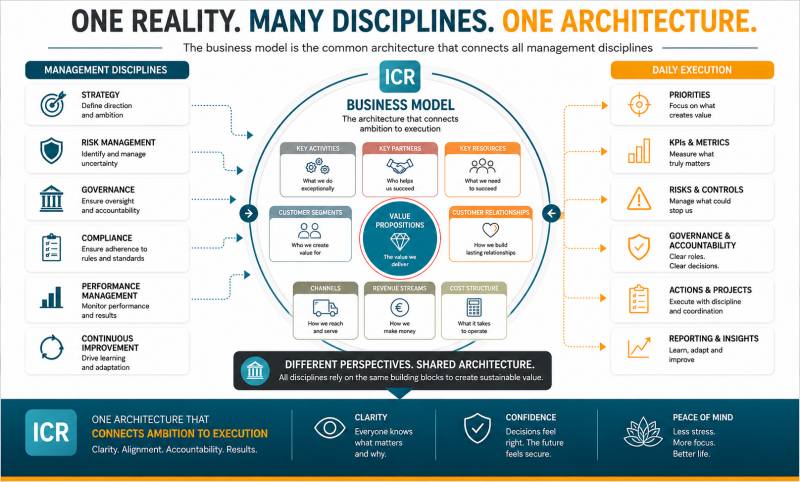
The business model is often treated as a strategic canvas used during a workshop, funding round or annual strategy process. Once completed, it may disappear into a presentation while daily management returns to budgets, projects and KPIs. That underuses its potential.
The business model can serve as the integrating architecture of the organization. It makes explicit how the organization intends to create value and which customers, propositions, relationships, channels, activities, resources, partners, revenues and costs are essential to that process.
These elements are not merely descriptive. They provide a common structure through which ambition can be connected to strategy, responsibilities, risks, performance and execution. Used in this way, the business model becomes much more than a picture of the organization. It becomes the architecture through which the organization can be managed and developed. It provides a shared answer to a fundamental question:
Which organizational elements must work together to create value consistently?
That question should come before the selection of KPIs.
The same architecture also helps define which conditions must remain protected, as explored in Why Organizational Resilience Begins with Explicit Continuity Goals.
From ambition to daily execution
Ambition gives an organization long-term direction. But ambition cannot directly guide every decision, responsibility or daily action. It needs an organizational structure through which it can become operational.
The business model can provide that structure. It translates ambition into the way the organization intends to create value. From there, management can determine which conditions must remain intact, how the organization needs to develop and what must happen in everyday execution. This creates a logical sequence:
Ambition → Business Model → Continuity → Strategy → Execution → Results
Each part has a distinct role. Ambition describes what the organization ultimately wants to achieve or contribute. The business model describes how value is created. Continuity Goals identify which essential conditions must be protected. Strategy determines how the business model needs to develop. Execution translates those choices into responsibilities, goals and actions. Results show what this organizational system produces.
KPIs belong at the end of this sequence. They provide feedback about the performance of the system. They should not become a substitute for designing and managing that system.
As explored in “Why Lack of Coherence Is the Greatest Obstacle to Organizational Development,” isolated management disciplines do not automatically form a coherent organization. The business model gives these disciplines a shared organizational reference point.
Protecting today before developing tomorrow
Using the business model as an integrating architecture also changes the way organizations think about continuity and risk. Traditional risk management often starts with the question:
What could go wrong?
That remains important. But a more fundamental question comes first:
Which conditions must remain intact for the organization to continue creating value?
For every essential element of the business model, the organization can define one or more Continuity Goals. These goals describe the conditions that must be maintained to protect the organization’s ability to operate and create value. For example:
- Which customer relationships are essential?
- Which knowledge, systems and resources must remain available?
- Which activities cannot be interrupted?
- Which partners create critical dependencies?
- Which revenue streams need to remain viable?
- Which cost structures must remain sustainable?
- Which value propositions must continue to meet a real customer need?
Only when those essential conditions are explicit can risks be assessed in their proper context. Risk management then becomes more than a catalogue of possible events. It becomes a structured way to protect the conditions under which value is created.
Strategy builds on this foundation. Continuity protects what must remain strong today. Strategy develops what must change for tomorrow. That creates a deliberate balance between protection and development.
A growing organization can look successful while its business model weakens
Consider a rapidly growing organization. Revenue increases, new customers are acquired and the main KPIs remain positive. At the same time, employees become overloaded. Operational knowledge remains concentrated in a few individuals. Customer relationships become less personal. Processes struggle to absorb the additional volume and exceptions increasingly require management intervention.
Measured only through growth and revenue, the organization appears successful. Viewed through its business model, a different picture emerges. Key resources are becoming overstretched. Customer relationships may be weakening. Core activities are becoming less reliable. Cost structures may no longer support the way value is delivered. The results still look good while the system producing them is becoming more vulnerable.
This is closely related to the leadership dependency explored in “Good Leadership Can Hide a Weak Organization.” Capable people can compensate for weaknesses in the organizational system. Strong short-term results can do something similar: they can temporarily hide deterioration in the underlying business model.
A positive KPI does not automatically mean that the organization producing it is becoming stronger.
From separate management disciplines to one organizational system
In many organizations, strategy, governance, risk management, performance management, projects and continuous improvement operate through separate methods, meetings and reporting structures.
Each discipline may add value. The problem arises when they have no shared architecture.
Strategy defines priorities. Risk management identifies threats. Finance monitors results. HR develops people. Operations improves processes. Project teams implement change.
But how do these activities connect around the way the organization actually creates value?
Without a common reference point, every discipline can optimize its own area while the organization as a whole becomes more fragmented. More coordination is needed. Decision-making slows down and teams spend increasing amounts of time resolving dependencies.
The business model can give these disciplines a shared structure:
- strategy develops specific elements of the business model;
- risks threaten the conditions required for value creation;
- responsibilities are assigned around essential organizational elements;
- goals and actions translate strategic choices into execution;
- management information shows whether the system is operating as intended;
- continuous improvement strengthens the relationships between the elements.
The objective is not to replace existing disciplines or methodologies. It is to connect them within one coherent organizational architecture.
The ICR Perspective
The ICR Organizational Operating System uses the business model as the integrating architecture between ambition and execution.
It connects long-term ambition to the way the organization creates value. Continuity Goals make explicit which conditions must be protected. Strategic Goals define how the organization needs to develop. Responsibilities, risks, controls, short-term goals and actions translate these choices into daily practice.
Management information then provides feedback on both results and the organizational conditions that produce them. This creates a continuous management cycle:
Design → Execute → Monitor → Learn → Improve
KPIs remain important within this cycle. But they gain meaning because they are connected to the business model, strategic choices and operational responsibilities behind them.
The organization no longer manages isolated numbers. It manages the organizational system that produces those numbers.
A practical test for management teams
A management team can test whether it is genuinely managing through the business model by considering several questions:
- Can we explain how our main KPIs connect to specific elements of our business model?
- Have we defined which conditions must remain intact for each essential element?
- Are our strategic priorities explicitly linked to the parts of the business model they are intended to strengthen or change?
- Is responsibility for these elements clear?
- Do we understand where the main dependencies and risks are?
- Can we trace strategic choices through to concrete goals and actions?
- Does our management information show only results or also the organizational conditions behind those results?
If these connections cannot be made explicit, the organization may be measuring performance without fully managing what produces it.
Predictability is designed
Predictable performance does not begin with a KPI dashboard. It begins with an organization that understands how it creates value and deliberately connects ambition, continuity, strategy and execution around that logic.
The business model provides the architecture for making those connections explicit.
When it is used as a living management structure rather than a static description, it helps the organization understand not only what results it has achieved, but also why those results occurred and whether they can be reproduced.
That is where sustainable performance begins.
Predictability is designed.
Predictability isn't a coincidence.
It is the outcome of an organization whose ambition, business model, strategy, execution and continuous improvement are deliberately connected.
That is exactly what the ICR Organizational Operating System is designed to do, using the business model as the integrating architecture that connects ambition, continuity, strategy, execution and continuous improvement.
Curious how predictable your organization really is?