
Most organizations don't suffer from a lack of ambition. They suffer from a lack of organizational design. Predictable performance is not the result of working harder—it is the result of deliberately connecting ambition, business model, strategy, responsibilities and execution into one integrated Organizational Operating System.
Originally published by Accountant.nl on May 7, 2026 under the Dutch title 'Langetermijnwaardeontwikkeling begint bij voorspelbaarheid en die wordt geborgd door het systeem'. This is the official English edition.
Integrating Growth, Risk and Quality as the Foundation for Predictable Value Creation
For financial professionals, it is not only the level of performance that matters, but above all its predictability over time.
In practice, many organizations have strategic plans but lack a consistent translation of those plans into clear priorities, ownership and recurring decision-making rhythms. Yet business continuity, enterprise value, risk management and financing capability are all directly linked to the ability to deliver consistent and repeatable results.
The real question is therefore not:
"How profitable is the organization today?"
The more important question is:
"How predictable will these results be over the coming years?"
One fundamental dimension is often overlooked. Predictability does not primarily emerge from reporting, dashboards or control mechanisms. It is created by the way leadership, decision-making and prioritization are structurally embedded throughout the organization.
Financial reports reveal outcomes. The organizational system determines whether those outcomes can be repeated. Financial performance is visible. The degree to which that performance is structurally reproducible often is not.
Many organizations appear financially healthy. Their annual reports provide little immediate cause for concern. Beneath the surface, however, increasing organizational complexity, fragmented strategic choices, shifting priorities, dependence on key individuals and reactive management gradually reduce the predictability of future performance.
These issues rarely appear immediately in financial statements. They first manifest themselves as declining predictability. For financial professionals this represents a latent risk. The question is therefore not if it will affect financial performance—but when.
Clarity at the Top as the Foundation
Predictable performance begins with a clear long-term ambition.
Organizations without a well-defined picture of where they want to be ten years from now naturally drift toward short-term optimization. Individual decisions may seem rational in isolation, but collectively they lack strategic coherence.
A clearly articulated ambition creates the opposite. It drives consistency in decision-making, focused investments, alignment between initiatives and stability in execution. The result is higher effectiveness, improved efficiency, better utilization of capital, stronger margins and EBIT, and above all a much higher degree of predictability.
Not because people work harder. But because the organization is managed more systematically.
The Hidden Cost of Operating Without an Organizational Operating System
Organizations without an explicit Organizational Operating System experience structural losses that often remain invisible.
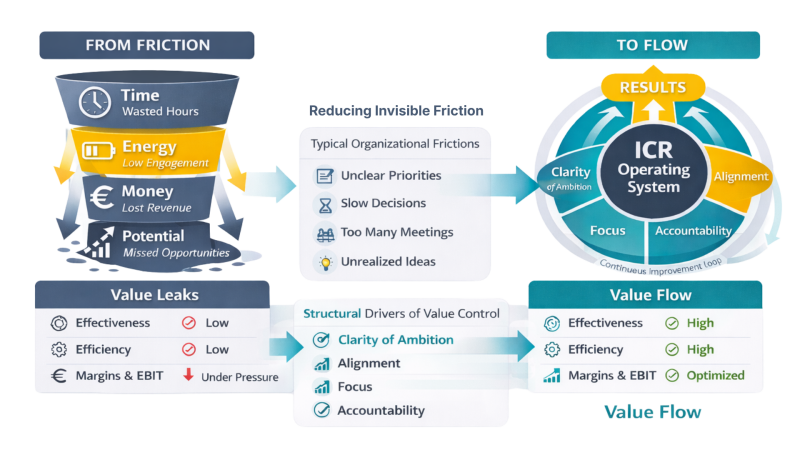
Time is lost because priorities are unclear. Energy is wasted through internal friction. Cash disappears through inefficient processes. Potential remains unrealized because the organization cannot scale effectively.
Rarely do these problems create an immediate crisis. Instead, they create variability. And variability increases organizational risk—even when today's financial results still appear acceptable.
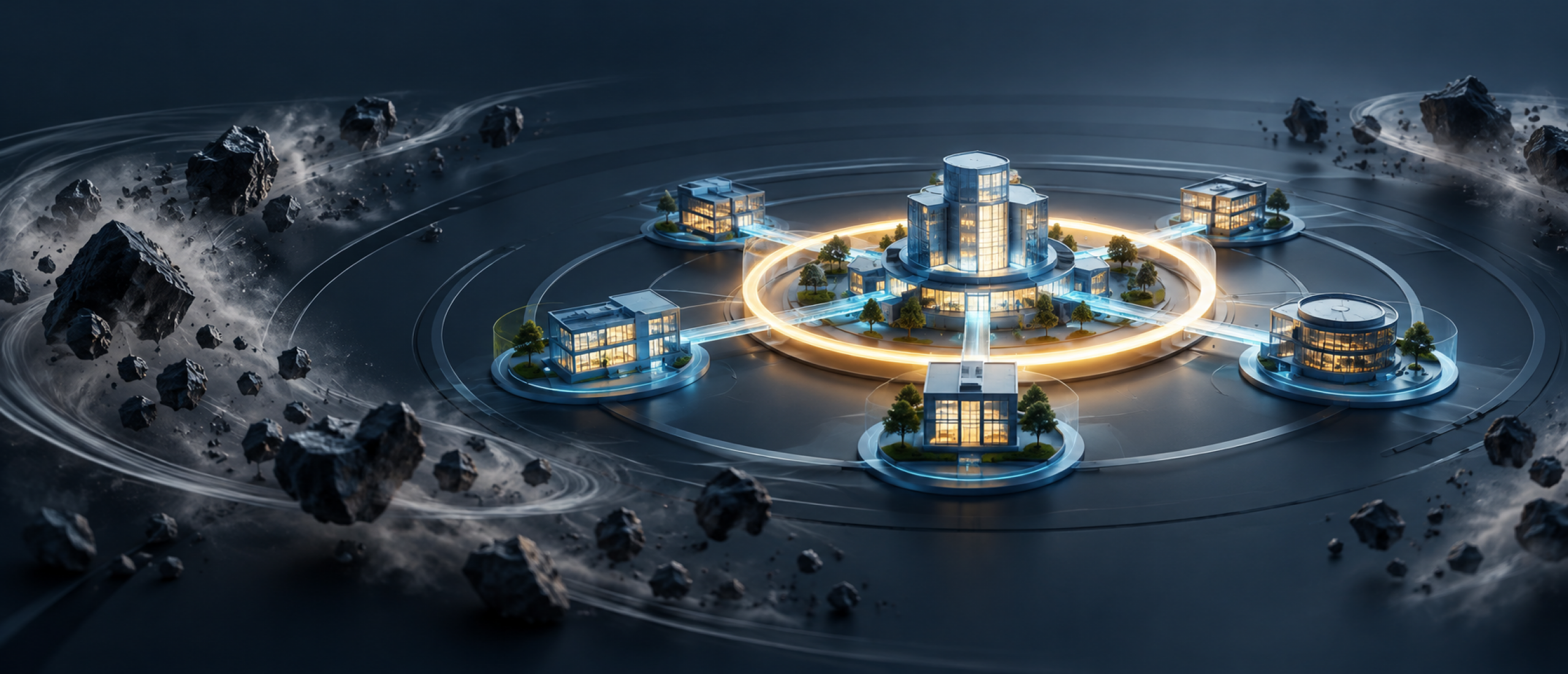
Predictability is a fundamental component of enterprise value. As illustrated by the ICR Value Flow Model, organizations can transform hidden organizational friction into a controlled flow of time, energy, money and potential.
Controlled Growth Requires the Integration of Growth, Risk and Quality
In many organizations, growth is viewed as the entrepreneur's responsibility, risk management as the accountant's domain, and quality as a compliance issue. However, sustainable value is created only when these three dimensions are integrated into one coherent management system.
Growth without explicit risk management increases vulnerability. Risk management without a growth perspective encourages defensive decision-making. Quality management without strategic direction gradually deteriorates into administrative overhead.
Controlled and sustainable growth therefore requires a management model in which long-term ambition guides growth, risks are explicitly incorporated into decision-making, and quality assurance becomes an integral part of daily execution.
When these elements come together within a single Organizational Operating System, organizations not only grow—they grow with control, consistency and confidence.
In practice, this means that growth, risk and quality are no longer managed through separate documents, isolated meetings or disconnected initiatives. They become part of one integrated way of working, supported by a digital management platform that connects ambition, governance, execution and continuous improvement.
The ICR Organizational Operating System is one example of how organizations can make this integrated way of working explicit and practically manageable through a connected digital management platform.
For accountants, this creates an entirely new opportunity. It raises an important question:
What role should the accounting profession play before risks become visible in the financial statements?
Rather than acting primarily as an auditor after the fact, accountants can become trusted advisors who actively support organizations in achieving controlled, sustainable growth.
Working with an integrated Organizational Operating System shifts conversations away from incidents and corrective actions toward direction, alignment and predictability. This not only strengthens strategic discussions with clients but also enhances the advisory position of the accounting firm itself.
The relationship evolves from transactional to developmental. The outcome is twofold:
- reduced organizational risk for the client;
- a more valuable and sustainable client relationship for the advisor.
From People-Dependent to System-Driven Organizations
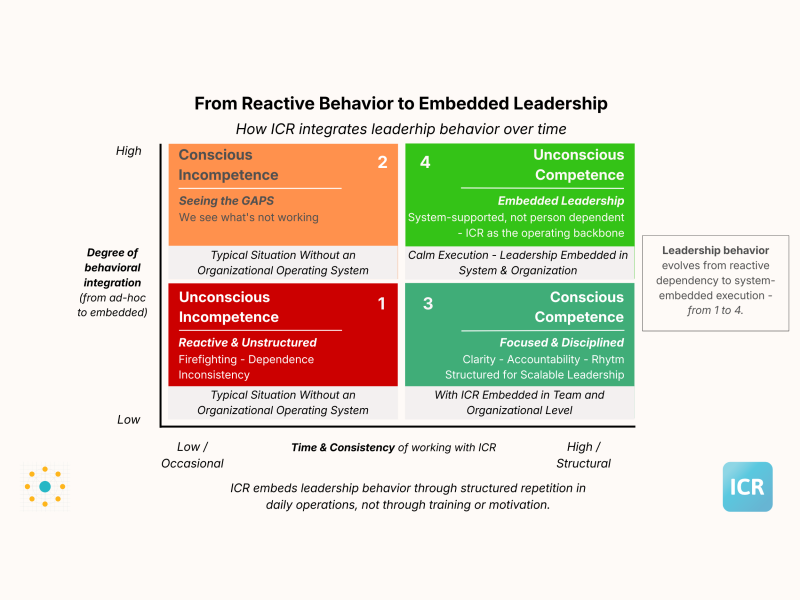
Organizations typically evolve through several stages of maturity. They often begin as reactive and highly dependent on individual knowledge and experience. As awareness grows, they enter a period of increasing complexity and instability.
Only after introducing clear structures, recurring management rhythms and explicit responsibilities do they develop into organizations where leadership is embedded within the system itself. It is only in this fourth stage that organizations become capable of delivering truly predictable and reproducible value.
Smaller organizations, particularly during the earliest growth stages, often operate in several maturity phases simultaneously. This makes consistent execution more difficult and reduces the predictability of future performance.
As long as organizational success depends primarily on the knowledge, experience or dedication of individual people, continuity remains vulnerable. The organization may function successfully today, but its performance cannot yet be considered structurally predictable.
Although culture and leadership play an important role, predictability cannot rely on culture alone. It requires governance that explicitly embeds decision-making, prioritization and execution within the organization.
At the same time, predictable organizations develop a strong sense of TeamIntuition: the collective ability of people throughout the organization to consistently make well-founded decisions within a shared strategic framework. Rather than relying solely on historical data or individual judgment,
TeamIntuition combines shared understanding, experience and observations to identify risks, opportunities and improvement potential at an early stage. A well-designed Organizational Operating System does not replace intuition. It strengthens, aligns and synchronizes it.
The essential questions therefore become:
- How is decision-making structurally organized?
- How reproducible is execution under changing circumstances?
- To what extent does value creation still depend on specific individuals?
If these questions are not explicitly answered in the design of the organization, predictability remains largely a matter of chance. As illustrated in the organizational maturity model below, organizations gradually evolve from reactive, people-dependent behavior toward system-driven leadership and reproducible performance. Business transferability provides a practical test of this transition. When You Become the Operating System of Your Business explores how owner dependency affects continuity, freedom and enterprise value.
Long-Term Enterprise Value as a System Characteristic
The transition from awareness to disciplined execution—and ultimately to a system-driven organization—does not happen through good intentions or training alone. It requires a consistent translation of long-term ambition into strategic goals, multi-year planning and daily execution.
When long-term value creation remains nothing more than an aspiration, it inevitably gives way to short-term priorities. That is why sustainable value should not merely be expressed as an intention. It must be systematically embedded in the organization's Organizational Operating System.
In practice, this means that a clear long-term ambition is explicitly defined and directly connected to the core elements of the business model. From these elements, strategic goals are derived and translated into a multi-year plan. The multi-year plan is then converted into short-term priorities, measurable actions and clearly assigned responsibilities.
When this entire chain is connected, strategic direction and daily execution become fully aligned. Every important decision can then be evaluated against two fundamental questions:
- Does this contribute to this year's objectives?
- Does it strengthen our long-term predictability and enterprise value over the next ten years?
Without this built-in dual perspective, organizations naturally optimize for the short term at the expense of long-term resilience. When this structural discipline is embedded in the organization, the opposite occurs.
Decision-making becomes calmer. Priorities become more consistent. Execution becomes more predictable. And value creation becomes increasingly reproducible.
Long-term enterprise value is no longer a strategic aspiration. It becomes a design characteristic of the organization itself. Sustainable value is not created through occasional excellence. It is created through systematic repetition in everyday operations.
From Behaviour to Predictable Performance
For many financial professionals, organizational behaviour feels like an abstract and difficult concept. Unlike financial results, behaviour appears difficult to measure. Yet behaviour becomes remarkably tangible once it is systematically supported.
A professional Organizational Operating System makes ambition explicit. It translates strategy into practical execution. It clarifies priorities. It makes progress measurable. And it embeds accountability throughout the organization. Using the business model as the integrating architecture.
As a result, behaviour is no longer viewed as a subjective or unpredictable factor. Instead, it becomes the natural consequence of a well-designed organizational system. Within that structure, there is ample room for TeamIntuition—the collective ability of teams to recognize what contributes to the organization's long-term ambition and what does not. Rather than replacing intuition, the system strengthens it.
Clarity creates confidence. Recurring management rhythms improve judgement. Shared reflection continuously enhances decision-making. This is where sustainable value creation truly begins.
Conclusion
Predictable performance is not an administrative outcome. It is the result of deliberate organizational design.
Organizations that structurally embed leadership, decision-making and execution evolve from reactive, people-dependent businesses into system-driven organizations capable of delivering consistent and reproducible performance.
This is where continuity is created. This is where organizations become more financeable. This is where genuine long-term enterprise value emerges.
Not because financial results are monitored more closely. But because the Organizational Operating System consistently supports, reinforces and embeds the behaviours required to achieve those results.
When this systematic support is enabled through one integrated digital platform, predictable value creation becomes far more than an inspiring vision.
It becomes a practical, repeatable way of working.
Predictability isn't a coincidence.
It is the outcome of an organization whose ambition, business model, strategy, execution and continuous improvement are deliberately connected.
That is exactly what the ICR Organizational Operating System is designed to do, using the business model as the integrating architecture that connects ambition, strategy, execution and continuous improvement.
Curious how predictable your organization really is?