

In this article, the original perspective on fragmentation and execution is expanded through the lens of organizational architecture and the ICR Organizational Operating System. It explores why organizations with capable people, clear strategies and numerous improvement initiatives can still struggle to produce consistent results.
Originally published in Dutch on Consultancy.nl on June 23, 2026, under the title “Gebrek aan samenhang vormt het grootste obstakel voor organisatieontwikkeling.” This English ICR Edition has been adapted and expanded to connect the original argument to organizational architecture and the ICR Organizational Operating System.
Why strategy, effort and improvement initiatives are not enough
Most organizations have ambition. They have a strategy, growth plans, dashboards, KPIs, projects and improvement initiatives. They employ capable people who work hard and genuinely want the organization to succeed. And yet daily reality often looks very different.
Priorities shift. Teams interpret the strategy differently. Decisions become increasingly reactive. Responsibilities overlap or leave gaps. Problems move between departments and more energy is spent on coordination, correction and internal friction.
From the outside, the organization may still appear to function well. Customers are served, targets may be achieved and urgent problems are usually resolved. But beneath those visible results, the organization gradually loses its ability to reproduce performance consistently.
And when performance becomes less reproducible, results become less predictable. The problem is rarely a lack of intelligence, ambition or effort. More often, it is a lack of coherence.
Strategy is rarely the real problem
A strategy only becomes meaningful when it influences priorities, responsibilities, decisions and everyday behavior throughout the organization.
In practice, the distance between strategy and execution can be considerable. Senior leaders may understand the intended direction, while teams face competing priorities, unclear ownership and short-term operational pressure. Departments may each optimize their own performance without fully understanding how their choices affect the organization as a whole.
The strategy itself may therefore be sound. The problem arises because it has not been translated into a coherent organizational system. This explains why adding another strategic plan, KPI dashboard or improvement program often produces less progress than expected. Each intervention may be valuable in isolation, but isolated improvements do not automatically strengthen the organization as a whole.
Local optimization can even increase fragmentation when every department introduces its own priorities, methods, terminology and reporting rhythm. The organization does not need more isolated excellence. It needs stronger connections between the elements that already exist.
Fragmentation is often mistaken for an execution problem
Organizations frequently describe the symptoms of fragmentation as execution problems:
- decisions take too long;
- priorities are interpreted differently;
- meetings produce discussion but limited progress;
- teams wait for information from one another;
- responsibilities are unclear when issues cross departmental boundaries;
- the same problems repeatedly return;
- important decisions escalate to the same few people.
These symptoms are real. But treating them separately rarely solves the underlying problem.
Another meeting may temporarily improve coordination. A new dashboard may make selected results more visible. A leadership program may improve individual behavior. A process redesign may strengthen one workflow.
But if ambition, strategy, responsibilities, decision-making, information, risks, goals and daily actions remain disconnected, the organization continues to depend on people bridging those gaps themselves.
That can work remarkably well for a long time. Until complexity becomes too great or one of the people holding the connections together is no longer available.
As explored in “Good Leadership Can Hide a Weak Organization,” strong people can compensate for weaknesses in organizational design. Coherence begins when the essential connections no longer depend entirely on individual memory, experience or intervention.
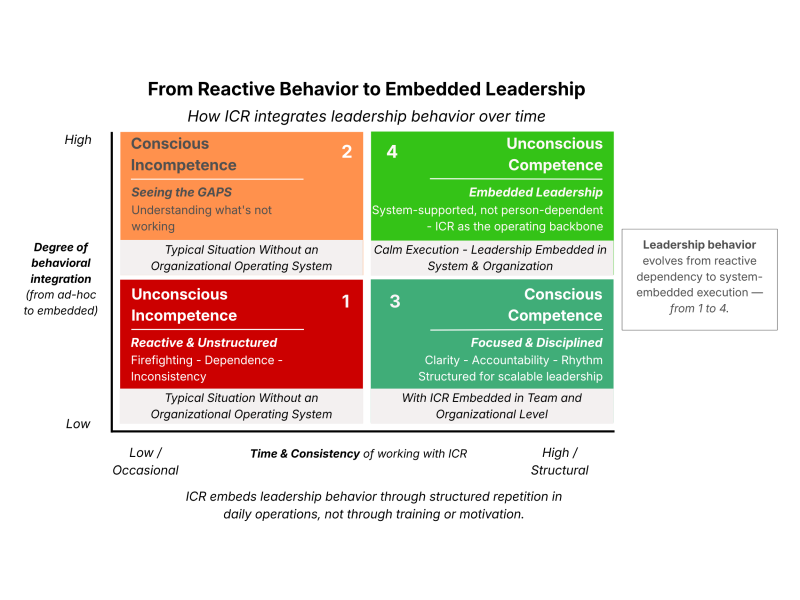
From person-dependent to system-supported performance
Person-dependent performance is not necessarily a sign of poor leadership. In the early stages of an organization, it is often both natural and effective.
Leaders remain close to customers, employees and daily operations. Decisions can be made quickly. Misunderstandings are corrected immediately and important information can be shared informally. But growth changes the conditions under which the organization operates.
More people, customers, processes, locations and decisions create more dependencies. The informal connections that once worked well become harder to maintain. Leaders can no longer personally oversee every interaction or correct every deviation. The central question then becomes:
How can the organization make good performance reproducible without continuously depending on specific individuals to hold everything together?
Processes alone are not enough. Nor are standalone management tools.
System-supported performance requires a coherent organizational architecture in which direction, responsibilities, decision-making, information, risks, controls, goals and actions reinforce one another.
This does not remove the need for judgment or leadership. It creates the conditions in which judgment and leadership can be applied more consistently and effectively.
The hidden cost of fragmentation
The cost of fragmentation is often underestimated because it does not appear as a single line in the financial statements.
It is distributed across the organization:
- time lost to unnecessary coordination;
- energy absorbed by internal friction;
- delays caused by unclear ownership;
- repeated correction of avoidable problems;
- initiatives that compete for the same capacity;
- decisions that depend on incomplete or inconsistent information;
- increased dependency on key individuals;
- reduced ability to adapt when circumstances change.
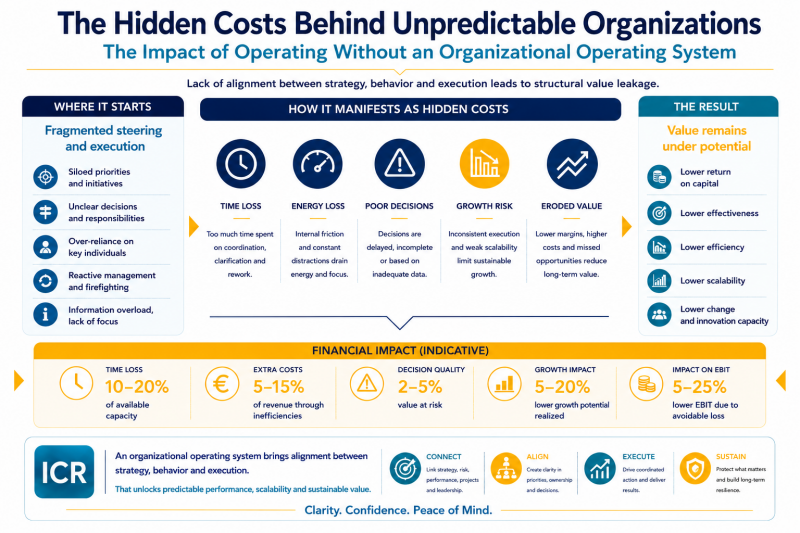
Each incident may appear manageable. Together, they create structural value loss. This is why apparently successful organizations can still feel exhausting to run. People work hard and problems are resolved, but a disproportionate amount of effort is needed to maintain performance.
The organization may be producing results, but it is doing so with unnecessary friction and vulnerability. Over time, that affects more than operational efficiency. It also affects scalability, continuity, resilience and enterprise value.
Why additional initiatives can increase the problem
When results become less predictable, organizations often respond by starting new initiatives. A culture program is launched. Processes are redesigned. New KPIs are introduced. Responsibilities are documented. Another software platform is implemented. Leaders receive additional training.
Each initiative may address a genuine need. The risk lies in treating them as separate solutions. Without an integrating architecture, every new initiative introduces additional concepts, priorities, meetings, owners and information flows. Instead of reducing complexity, improvement itself can become another source of fragmentation.
The issue is therefore not whether an individual initiative is useful. The question is how it connects to the rest of the organization. Does it support the long-term ambition? Does it strengthen the business model? Are responsibilities clear? Does it influence daily decisions and behavior? Can progress be monitored within the existing management rhythm? Does it reduce uncertainty or merely add another layer of activity?
Organizational development becomes sustainable when improvements reinforce one another rather than compete for attention.
Coherence does not mean more bureaucracy
The need for stronger organizational coherence is sometimes interpreted as a call for more rules, procedures and centralized control. That is not the objective. A coherent organization does not prescribe every action. It makes the essential context explicit so that people can act with greater clarity and autonomy. People understand:
- where the organization is going;
- how it intends to create value;
- what their responsibilities are;
- how their work connects to other parts of the organization;
- which priorities should guide decisions;
- when they can decide independently;
- when coordination or escalation is required;
- how the organization learns and improves.
This kind of clarity reduces the need for constant supervision. It allows decisions to be made closer to where the relevant knowledge exists, without losing alignment with the organization’s direction. The result is not rigidity. It is coordinated autonomy.
Team intuition as an accelerator of execution
Well-organized teams often appear to make good decisions almost instinctively. That is not accidental. When people repeatedly work with the same direction, priorities, responsibilities and decision principles, they develop a shared understanding of what matters. They become better able to anticipate the consequences of decisions and understand how their actions affect the wider organization.
This creates team intuition: the collective ability to make timely decisions that remain aligned with the organization’s long-term direction. A strong organizational system does not suppress intuition. It sharpens and synchronizes it. Without shared context, intuition remains individual. Different people may make reasonable decisions based on different assumptions. With shared context, professional judgment becomes more consistent across teams and organizational levels.
That is an important source of scalability. The organization becomes less dependent on continuous intervention from above because people can act independently without losing coherence.
The ICR Perspective
The ICR Organizational Operating System starts from a simple principle: sustainable performance depends on the quality of the connections within the organization.
Ambition, business model, strategy and execution should not operate as separate management disciplines. Responsibilities, risks, controls, goals, actions and management information should not function as disconnected mechanisms either. Together, they form one organizational system.
ICR brings structure, focus, alignment, mindset, behavior, rhythm, discipline and embedded leadership together within that system. The purpose is not to prescribe one universal way of organizing. It is to make the organization explicit enough for people to see the relationships, dependencies and possible gaps that influence performance.
This allows organizations to work on individual priorities without losing sight of the whole. The objective is coherence rather than uniformity. Different teams can have different responsibilities, expertise and working methods while remaining connected to the same ambition, organizational logic and strategic direction.
That is how fragmented activity gradually becomes aligned execution.
A practical test of organizational coherence
A management team can begin by examining five questions:
- Direction: Do people understand the organization’s long-term ambition and current strategic priorities in the same way
- Connection: Can teams explain how their work contributes to the business model and affects other parts of the organization?
- Responsibility: Is it clear who owns important outcomes, decisions, risks and follow-up actions?
- Execution: Are priorities consistently translated into goals, actions, information and management rhythms?
- Continuity: Would the essential connections continue to function if one or two key people became unavailable?
The answers reveal more than the quality of individual processes or departments. They show whether the organization functions as an integrated system. When those connections remain implicit, performance depends heavily on interpretation and individual intervention. When they become explicit, the organization gains clarity, learning capacity and the ability to reproduce results more consistently.
Predictability is designed.
Predictability grows from coherence
Predictability does not mean that every outcome can be known in advance. Markets change, unexpected events occur and organizations must continue to adapt. It means that the organization itself provides a dependable foundation for responding to uncertainty.
People understand the direction. Responsibilities remain visible. Decisions follow clear principles. Information reaches the right people. Risks and deviations are recognized earlier. Improvement becomes part of daily execution rather than a separate initiative.
That is what coherence makes possible. And it is why the quality of an organization should never be judged only by the results it produces today. The more revealing question is how consistently, independently and sustainably it can continue producing them as complexity increases.
Curious how coherent and predictable your organization really is?