

In this article, the original perspective on leadership dependency is expanded through the lens of organizational architecture and the ICR Organizational Operating System. It explores a fundamental question: is performance embedded in the organization — or does it still depend on key individuals holding everything together?
Originally published in Dutch on ManagementSite on August 18, 2026, under the title “Goed leiderschap kan een slecht systeem lang verbergen.” This English ICR Edition has been adapted and expanded to connect the original argument to organizational architecture and the ICR Organizational Operating System.
How to build an organization that becomes less dependent on its leaders
Organizations often invest in leadership development when results fall behind, collaboration becomes difficult or employees fail to take sufficient ownership. That makes sense. Good leadership matters. But strong leaders can also compensate for weaknesses in the organization itself — sometimes for years.
They connect departments that would otherwise operate in isolation. They know which customer needs extra attention and which project is about to run into trouble. They understand exceptions to processes that were never properly documented and know from experience which decision needs to be made in a particular situation.
All of this is valuable. But it can also hide something important:
Is the organization performing well because it is well designed — or because capable people continuously compensate for what the organization itself has failed to organize?
That distinction matters.
When the leader becomes part of the operating system
Consider what happens when such a leader leaves, becomes unavailable or simply can no longer be everywhere at once. Connections that appeared to work suddenly break down. Decisions take longer. Priorities become less clear. Problems that used to be resolved almost automatically begin to surface.
The organization has not necessarily become weaker overnight. Its existing weaknesses have simply become visible.
In practice, experienced leaders often carry an enormous amount of organizational knowledge in their heads. They know how things really work, who needs to speak to whom, where risks are emerging and when formal procedures should be interpreted differently.
Over time, the leader effectively becomes part of the organization’s operating system. And that creates dependency. In owner-led companies, this dependency also becomes a direct test of transferability, as explored in When You Become the Operating System of Your Business.
Strong performance does not automatically mean a strong organization
This is one of the more difficult organizational vulnerabilities to recognize because the visible results may still be good. Customers are satisfied. Problems get solved. Targets are achieved. Employees know whom to call when something goes wrong.
From the outside, the organization may appear healthy. But underneath those results, people may continuously be bridging gaps between strategy, responsibilities, processes, information and decision-making.
The better they are at doing this, the less visible those gaps become. That creates a paradox:
Strong people can make a weak organizational design look strong.
And as organizations grow, this becomes increasingly difficult to sustain. Complexity increases. More customers, employees, processes, decisions and dependencies have to be coordinated. Eventually, individual capability can no longer compensate for organizational ambiguity.
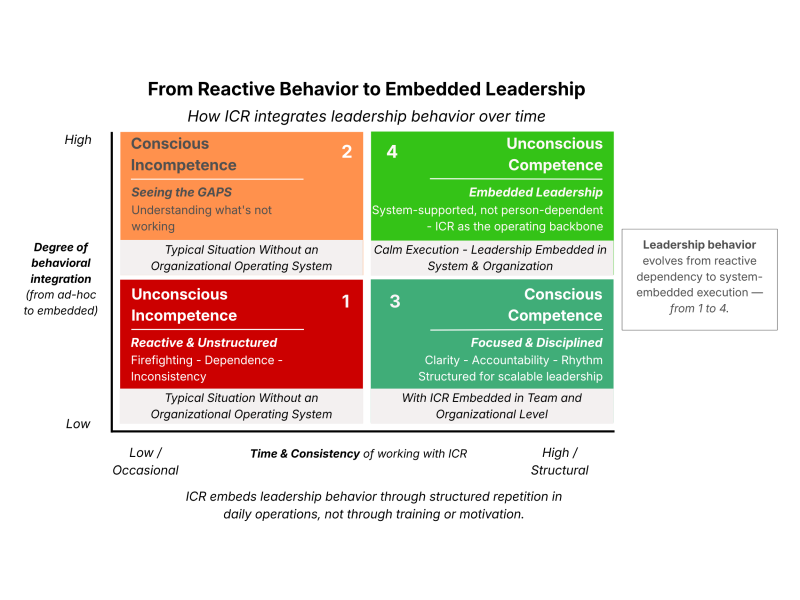
The alternative is not to make leadership less important, but to embed essential leadership principles into the way the organization operates. Direction, priorities, responsibilities, decision-making, feedback and continuous improvement should increasingly become part of the organizational system rather than depend on repeated individual intervention.
That is what we mean by embedded leadership.
The real question is not whether you have good leaders
Leadership remains essential. The more useful question is whether your leaders operate within a strong organization or whether they are required to hold that organization together. Those are fundamentally different situations.
A well-designed organization makes essential connections explicit. People understand the direction of the organization, what they are responsible for, how their work connects to other parts of the organization and how decisions are made.
Knowledge does not disappear when one person leaves. Problems do not automatically escalate to the same few individuals. Strategy does not depend on constant management intervention to reach everyday execution. Good leadership then strengthens the organization instead of compensating for it.
From leadership dependency to organizational architecture
This is where the issue becomes larger than leadership itself. An organization is a system of interconnected elements: ambition, business model, strategy, people, responsibilities, processes, information, risks, controls, goals and actions. If these elements are not deliberately connected, people will connect them themselves. That can work remarkably well. Until it doesn't.
The business model can provide the integrating architecture for these connections. It makes explicit how the organization intends to create value and provides a common structure for connecting strategy, people, responsibilities, processes, resources, risks and performance.
The challenge is therefore not to eliminate the importance of people. Quite the opposite. It is to create an organizational architecture that allows people to contribute their judgment, experience and creativity without requiring them to continuously compensate for structural gaps.
This is also why reducing key-person dependency is not primarily an HR issue. It is an organizational design issue.
The ICR Perspective
The ICR Organizational Operating System starts from the principle that sustainable performance requires the organization itself to become explicit.
Ambition, business model, strategy and execution should not exist as separate management disciplines. Responsibilities, risks, controls, goals and management information should not operate as disconnected mechanisms either. They form one organizational system.
By making those relationships explicit, organizations can gradually reduce their dependence on individual intervention and increase their ability to turn ambition into results consistently.
The objective is not an organization that can operate without leaders. It is an organization in which leaders no longer need to be the invisible architecture holding everything together.
That distinction becomes increasingly important as organizations grow, leadership changes or complexity increases. And it leads to a useful question for any management team:
If one or two of your strongest leaders were unavailable tomorrow, which essential connections in your organization would disappear with them?
The answer says something important about the quality of the organization itself.
Predictability is designed.
Predictability isn't a coincidence.
It is the outcome of an organization whose ambition, business model, strategy, execution and continuous improvement are deliberately connected.
That is exactly what the ICR Organizational Operating System is designed to do, using the business model as the integrating architecture that connects ambition, strategy, execution and continuous improvement.
Curious how predictable your organization really is?