icr academy strategic goals vs continuity goals

33 Overarching ICR objectives

Within organizations, there are various types of goals, each serving a specific purpose. To keep everything organized, we work with 33 overarching ICR objectives within the ICR Cycle. The ICR objectives serve as essential guidelines for the careful and complete implementation of business operations within organizations.

Different types of goals

Within organizations, there are various types of goals, each serving a specific purpose. Strategic goals focus on the long term, shaping the organization's vision and growth. Tactical goals translate this strategy into concrete actions for the medium term, while operational or continuity goals aim to ensure the smooth running of daily operations. Compliance goals ensure that the organization adheres to laws and regulations, while innovation and sustainability goals are geared towards renewal and reducing the environmental impact.

Additionally, there are goals related to different business functions. These include goals focused on marketing, sales, ICR, HR, procurement, core processes, investments, and quality.

To keep this comprehensive structure manageable, we use 33 ICR objectives within the ICR Cycle. These ICR objectives are overarching and serve as guiding principles for a careful and thorough implementation of business operations within organizations.


ICR Objectives form a holistic framework

ICR Objectives Form a Holistic Framework

Within the ICR cycle, we arrive at a structured implementation of business operations through the framework of 33 ICR objectives. These are uniform and applicable to all types of organizations. ICR objectives are overarching and act as preconditions for a careful and as complete as possible implementation of business operations. The ICR objectives include strategic, operational, compliance and care goals. But they also give substance to management information and the preservation of valuable elements, such as staff and resources. As a result, business operations are and remain complete and consistent at all times. 

The ICR objectives thus offer a structured approach to organizing and optimizing business processes. They are not necessarily limited to one type of goals (such as strategic, tactical or operational goals), but form a holistic framework in which the different types of goals find their place. This means that within the 33 ICR objectives, a distinction can be made between strategic, operational, compliance and care goals. This depends on the focus of the specific goal. 

Within the ICR cycle, we make an explicit distinction between the strategic goals and the so-called continuity goals (also known as: regular goals). Below, you can read why this distinction is important.

The man behind the ICR Growth & Success SaaS Platform

Paul Joore - Founder ICR

"ICR helps people & organizations to find ánd realize their real dream, their true ambition. All for pleasure in work, a good work-life balance and therefore a positive mindset. Not using ICR is like robbing your potential and future self."
"Master Your Purpose. Own Your Freedom. With ICR."
The ICR cycle and Strategic goals vs Continuity goals

Strategic goals vs Continuity goals

Within the ICR cycle, we explicitly distinguish between strategic goals and continuity goals (also known as: regular goals). And we mainly do that to keep things organized. The future of your organization depends on the strategy and therefore on the strategic goals. While the continuity goals mainly determine the overall stability of your organization. 

In other words, strategic goals are long-term and overarching goals that focus on the growth, development and transformation of your organization. They are forward-looking and give direction to the overall vision and course of your organization. They often include new markets, innovations, or profound changes to position your organization for long-term success. 

Continuity goals are goals that ensure that daily operations function stably, predictably and reliably. They focus on structurally delivering performance and making desired behavior visible on a daily basis. These goals help you stay your organization viable and meet immediate needs. All without drastic changes or transformations.

Are you the leader who grows your business?

Professionalism for sustainable success in organizations and companies

Ready for Growth Scan through 8 statements

Take the ICR Growth Scan
Ready in 2 minutes
Expression of sustainable success

Conditions for winning team present/not present

How is your company scoring?
Ready in 5 minutes
Manageable and controlled growth for sustainable success

Conditions for goal-oriented entrepreneurship?

How is your company scoring?
Ready in 30 minutes
Example of strategic goals within the ICR cycle

Example of strategic goals within the ICR Cycle

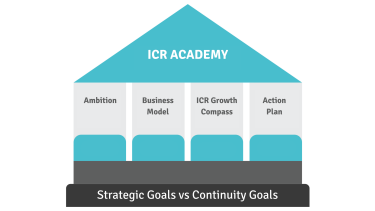
Within the ICR cycle, the structure of the strategic goals is formed by the elements of the Business Model Canvas. And therefore because of the way in which your organization's business model has been shaped. To achieve each of these strategic goals, you will draw up a long-term plan. And from that long-term plan, you decide which short-term goals will be implemented for this long-term plan.  

Within the BM element “Customer segments”, the goal is to expand into new geographical markets and thus new customer segments. And this is linked to the strategic goal: “We want to introduce our products in five European countries (Germany, France, Spain, Italy, and Sweden) within three years (by the end of 20xx), with an expected sales growth of 20% in those markets. “By the way, this also affects the BM element “Revenue Streams”.  

The long-term plan then states that this should be done by launching local marketing campaigns and new distribution partnerships. By the way, this also affects the BM element 'Channels'. Afterwards, you outline the long-term plan with short-term goals. Q1 of Year 1: Conduct market research in the five target markets. Q2 of Year 1: Identify local distribution partners and negotiate initial contracts. Etcetera. 

Via the Action Plan, you always have an overview within the ICR cycle. And is it 100% clear to whom you have assigned which goals. And, of course, within which ICR objective and within what timeframe it must be achieved. 

Example of strategic goals within the ICR cycle

Example of continuity goals within the ICR Cycle

Continuity goals arise from the way in which InControlRating B.V. value delivers (see business model) and are subsequently secured and executed within the 33 ICR objectives.


For example, within the area of responsibility “Marketing& Sales” and more specifically the objective “Translate marketing plan into sales policy& sales plan”: 

  • Structurally achieving turnover — “We achieve stable sales every month through consistent use of online ads and sales promotions.” 
  • Achieving structural customer retention — “We actively maintain customer relationships that keep customers engaged and make repeat purchases.” 


Or the following regular goals within the area of responsibility 'ICT' and more specifically the objective 'Strategic ICT plan'.

  • System upgrades — “Our systems are continuously up to date and function reliably and securely. “
  • Providing reliable IT support — “We ensure that IT issues are resolved quickly and effectively, so that systems continue to function continuously.” 


Or within the “HR” area of responsibility and more specifically the “Strategic HR plan” objective.

  • Reducing absenteeism — “We structurally ensure a healthy work environment where employees remain employable and involved. “
  • Structurally employable employees — “We ensure a healthy work environment where employees remain employable and engaged.


Via the Action Plan, you always have an overview within the ICR cycle. And is it 100% clear to whom you have assigned which goals. And, of course, within which ICR objective and within what timeframe it must be achieved.

At ICR, we adhere to 5 Growth Principles that serve as a solid foundation for the ICR Cycle: the successful process from ambition to results